Saturday, January 9, 2010

Thoughts on Issues in the Theology of Scripture Part 2: The Idea of the Bible


Greetings, faithful readers!

Welcome to Part 2 of my new blog series discussing the course I'm currently taking entitled "Issues in the Theology of Scripture." If you would like to know what this series and the course are about you can check out the introductory post linked below. If you would like to read Part 1, which reproduces an essay I composed for the course on the topic "What do we mean when we say that the Bible is true and what methods of interpretation help us to appreciate its
truthfulness," check out the link for Part 1 below.


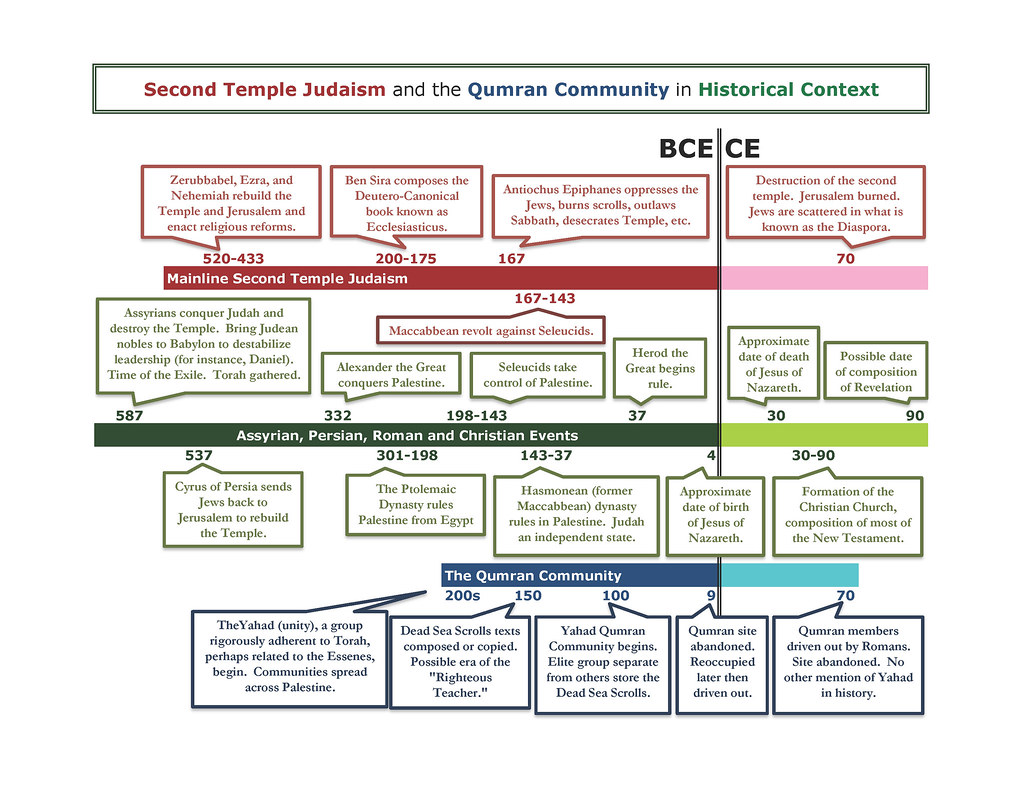
This second post will address a few ruminations I derived from the lecture and presentation given by my professor, Shane, this past Thursday. The topic for the day was "The Emergence of the Idea of the Bible in the Second Temple Period." Let me give you a brief overview of the material Shane covered in order to then create some linkages to my own thought.

As our assignment for the previous night, Shane had us read a few texts from what is known as the Second Temple Period. With a little wiggle room for scholarly debate in Jewish/Biblical History, the Second Temple Period is the time stretching from the Israelite return from exile (approximately 537 BCE) until the destruction of the eponymous second temple by Romans quelling a Jewish Revolt (70 CE).


Wednesday, January 6, 2010

Thoughts on Issues in the Theology of Scripture Part 1: The Initial Essay


Greetings again, faithful readers. Reprinted below you can find my initial essay for my course in Issues in the Theology of Scripture. If you want to know more about the impetus behind this series of posts and the course that inspired them, please read this post.

Our professor assigned us a 1500 word essay (approximately 4 and 1/2 pages) addressing the topic "What do we mean when we say that the Bible is true and what methods of interpretation help us to appreciate its truthfulness" as if we were discussing it with an educated layperson. This assignment, to be blunt, was agonizing. So many thoughts ran through my head, I didn't know where to start. How could I address this huge topic in four pages?

I ended up starting with a blank slate, as it were, answering the question by simply picking up the Bible and looking at it, then slowly weaving in historical and theological questions as they arose from my ponderings. This ended up producing what I think is a coherent, self-contained essay, but it also left me feeling strange. Only after being in conversation with others this morning in class did I realize that I had left out two of the most important things about the Bible to me: a) story and b) a relationship with Jesus Christ, the cornerstone and primary revelation of God. Wow! What an oversight. But somehow they didn't arise in the flow of the essay and, as I had already written 1900 words and had to cut down, I couldn't shove them in without breaking the essay. I will write a post, possibly this weekend, containing my thoughts on these two very, very important things to me and I also might include them in my final paper for the course, which is a revision of this initial essay. I will post that final paper here as well.

For now, peruse my thoughts as derived from a broad-based view of just picking up the Bible and thinking about it organically. Please leave comments below. (Be nice if these comments happen to lead to strenuous discussion).

Thanks in advance faithful readers! Oh, and if you want another version of this essay, please read the one posted by my friend Jeff over at his blog: Theological Mishaps.

-----------------------------

"What do we mean when we say the Bible is 'true,' and what methods of interpretation help us to appreciate its truthfulness?"

This question is difficult because it would be so simple to answer: it is true because it is true and people have said so for centuries. Yet this is not satisfactory for skeptics who are unsure of the Bible and historians who analyze it. The Bible has been used to perpetrate horrible wrongs: slavery, torture, war. The observable fact of denominationalism demonstrates that different people also find different truths, or different slants on the same truth in the Bible.

Perhaps it would be helpful to begin by describing what we can accurately say about the Bible through cursory observation and reading of a Bible most people could obtain. Firstly, it is a book, words written on a page. This indicates that someone wanted to preserve its contents in a medium more permanent than one person’s memory, either for personal reasons, or for the benefit of others. Secondly, it is a collection. Its table of contents attests to two testaments and sixty-six books. It is not a single piece of literature written from one person’s imagination, but an assortment of writings gathered together either by one person or a group of people who think that its various parts relate to each other. This book was gathered for reasons involving preservation and relation. Whether or not the original authors of each book intended their works to be read by others, those who have maintained the collection have copied and distributed it, indicating that their reason for its preservation is that it might be shared. So, how do its disparate parts relate?

The Bible professes to span from the creation of the world and the history of a single family, through a nation, to the life of a particular man and the community he started. It contains history, biography, narrative stories, aphorisms, poetry, and letters. Its larger setting is Earth, though some scenes occur wherever God resides; its more immediate setting is the land surrounding the Mediterranean Sea. Its cast numbers in the thousands. The most common thread in this complex collection is that every book gives an account of either human encounters with God or human relationships with other humans. Though each book was composed for a different reason, mostly unknown to us, we can at least say with confidence that this common thread runs throughout.

So, this collection of works has been preserved for thousands of years in order to share its thoughts on human-divine and human-human relationships. A working definition of whether or not the Bible is true, then, might involve asking whether or not it accurately portrays human-divine and human-human relationships or describes ways in which these relationships might be improved. Now a host of other troubles appear. Some people do not believe God exists. For them, the Bible cannot be true in our definition because it describes something that does not exist. They might speak of its truthfulness by noting the usefulness of its thoughts on morality and ethics. Certainly the Bible contains much about morality, setting forth both good and poor examples of right living. Yet leaving God out of the book would mean cutting out more than half of its contents. So, though morality and ethics are certainly an integral theme of the Bible, they are not its primary theme.

Other people attempt to prosecute or defend the Bible’s truthfulness based upon its historical accuracy. Yet, not only do there seem to be contradictory accounts in the Bible (two chapters on creation in stark contrast; two accounts of monarchies in 1 and 2 Kings and 1 and 2 Chronicles that differ in a few details; four gospels with similar traits, but which are also wildly dissimilar), but also the copies that we have of the Bible contradict each other. Some words differ; some grammatical markings have been altered. It was also written in several different languages, most considered “dead,” and one (Hebrew) that was originally written without vowels. It is difficult to tell, sometimes, what the Bible is attempting to express, much less judge its historical accuracy. Yet, in larger ways, and in comparison with other documents from the Mediterranean area, it does describe many historical things accurately: places, people, events. In this way also, it can be spoken of as true, but not without qualifications

Most, however, when speaking of the Bible as true, would describe in a way harder to pin down with facts, figures or laws. For them, its truth lies in how it can speak in their lives. When they view the world through the Bible, things fall into place and their life makes sense. It helps them to grasp onto something outside of themselves; it draws them together with others in community; it gives them a purpose in life; it gives some explanation, or at least comfort when nonsensical and painful things occur. They have tested its claims about divine-human and human-human relationships in the field of life and found them to be accurate. It improves their relationship with other people and with the God in whom they believe. This is the primary sense in which many people say that the Bible is true.

Yet, the Bible has been used to break relationships and cause pain. How can the Bible’s adherents speak of its truth in the face of this misuse and how can they avoid these mistakes themselves? Careful attention to several points previously mentioned might provide clues. Firstly, they must remember that it is a collection, and this includes understanding its seeming contradictions. A better word, with a different connotation might be inserted here: not contradictory, but complementary. Certainly those who gathered the Bible could see with four gospels and two creation accounts side by side that there were differences. We can assume that they intended to include multiple voices and points of view. Another way of saying this is that one of the things the Bible expresses about divine-human and human-human relationships is that various people describe these relationships differently and that these different voices must not be sidelined, but considered together. If this is so, we cannot ignore reading the Bible as a whole, and where contradictions occur, we must try not to force a unified answer, but see how the accounts interact and to comprehend the song that the chorus of voices is singing.

We also cannot ignore the particularity of the Bible. It was written by particular people in particular settings in a particular time in history. Mostly, these people were not the majority. The Israelites were slaves in Egypt, marginalized. Even when they escaped and began their own country, they were always surrounded by greater powers that eventually conquered and enslaved them. As Jews, Jesus and his followers were also in the minority, under the rule of the Roman Empire. Jesus often disagreed with the Jewish authorities, putting himself and his followers on the outside. As Jesus’ followers began spreading his word to Jew and Roman and everything in between, they eventually created a new religious group, one not tied to nation or ruler, something unusual in the Roman Empire, making them once again a minority. In order to understand what the Bible says about relationships, we must understand its context and how it is different from ours. This also entails trying to grasp the languages in which the Bible was written and the cultures that gave it context, despite the difficulties of doing so.

Finally, these works were read in gatherings, discussed in groups, commented on by many. Though the Bible can be read for personal spiritual nourishment, it is best read in conversation with others. Again, its complementary nature encourages this. The surest way of avoiding misinterpretation of the Bible is by reading it in conversation. These conversation partners, as the previous paragraphs subtly imply, include the skeptics and historians, who force us to pay attention to its context and moral and ethical themes, to look at it closely and carefully.

Much more could be said about the Bible and its truthfulness. We have not even touched upon the books known as the Deutero-canonicals that are included in some Bibles and not in others. We have not discussed the ways the Bible has been and continues to be a driving force in culture and the abuses and interpretations that arise from this. We have not mentioned the differences that crop up in speaking of the truth of the Bible as it is translated into multiple cultures and languages. Yet, in each of these cases, the overarching lessons of reading the Bible carefully, contextually and in conversation and community are useful in mitigating some of the thornier issues and allow us to say with confidence that the Bible truthfully and accurately portrays divine-human and human-human relationships.

The Beginning of a New Blog Cycle: Thoughts on Issues in the Theology of Scripture


Well, it has been a long time since I've blogged. Life became extremely crowded last semester, what with a 15-hour a week job, a 15-hour a week internship and three intense classes (oh, and living life and loving my wife as well). Right now I'm taking a month-long course on Issues in the Theology of Scripture, which meets for three hours in the morning, leaving a little bit more time on my schedule. I've decided that this class, which so far has been wonderfully thought-provoking, might provide some good fodder for blogging. What I'm proposing to do is to post thoughts on the course (which began on Monday and so far has involved writing a 1500 word essay) every day that I can. I've asked my professor -- who will be referred to as Shane in the posts -- if I can quote him, or refer to his ideas if they are the seeds of my thought for these posts, and he has agreed that I can refer to him as long as the references are not wholesale transcriptions of his lectures or audio files (which they won't be) and that I accurately represent his views.

I hope to ponder the theme of the course, which Shane put before us on Monday, of wandering around in the gap between theology and biblical studies. I will go more into detail of what this gap entails and why it exists as Shane explains it to us in class, but in brief, let's just say that in higher education there exists a separation of disciplines. In most higher ed institutions divisions are placed between the sciences and the arts and the humanities, and also within each of these between history and english or philosophy, for instance. In Seminary, you often see this division of disciplines into: Biblical Studies, Practical Theology, Theology and Church History. The difficulty that sometimes arises in pursuing these studies is that the folk in the Biblical Studies department take very seriously the questions that have come from a historical-critical way of looking at the Bible: reading texts in original languages, studying their cultural, historical and political contexts, trying to work out how the texts were written, formed, passed down, etc. This method is a product of the Enlightenment. Meanwhile, the Theology department spends perhaps a class period on a theology of scripture, often avoiding questions that deal with the difficulties presented by the historical-critical method. These problems sometimes involve the inerrancy or infallibility of the Bible, the contradictions that can be found in the Bible (or seeming contradictions, I'm sure we'll get into this later), the grammatical differences between different copies of the Bible, what it means for the Bible to be divinely inspired and how this bears out when the Bible gets into human hands or when it is translated into different languages. So, the Biblical Studies department takes these questions seriously, but they are often in the background and understanding why these questions are important and what they mean for the life of faith and everyday living is not considered. Or, on the other hand, the Theology department discusses briefly a theology of scripture but does not consider how this might come to bear in practice or what a theology of scripture that takes into account the questions might look. This course tries to put these background questions into the foreground and to address them in a thoughtful and sensitive way.

It also attempts to equip students with tools to read what Shane calls the "Barnes and Noble School of Theology and Ancient Scriptures." By this he means the popular books that are widely available in major bookstores and have entered the general culture and conversation: Bart Ehrman's Misquoting Jesus, or Dan Brown's The DaVinci Code, for instance. While these books bring up interesting points that speak to the Historical-Critical method, the outcomes of their discussion can be misleading and they do not always speak to the theological or practical outcomes of the difficulties they mention. If you want a good introduction to this debate, check out Stephen Colbert's interview with Bart Ehrman, which Shane used as a catalyst for his initial lecture. The video is embedded below:


So, now that you know a bit about the course, you can follow along on this blog for the next few weeks as I share with you what I'm learning and what I'm thinking. I'll begin with the essay that we had for the course, which answers the question: "What do we mean when we say that the Bible is true, and what methods of Biblical interpretation help us to appreciate its truthfulness." This essay will be revised at the end of the semester. I'll post it in a separate post from this.

Thanks, as always, for sticking with me faithful readers!

Wednesday, September 30, 2009

A "Brief" Update from the Newsdesk and a Meditation on Trains and Railroad Tracks


Just a brief update from the life of Marc. Life is good. Hectic? Yes. Sleepiness-inducing? Yes. Good? Definitely. My current schedule involves waking up between 6:30 and 7:00 AM after ignoring a beeping alarm for at least half an hour. Sarah and I then do crunches while listening to a worship song. Shower, breakfast and checking morning e-mail usually follow in some sort of order. Then, we're off to school at around 8:20, give or take ten minutes. From there, Monday through Thursday, I'm either in class or at work at the bookstore until 5:30/6:00 PM, at which point I (and sometimes Sarah) head home to cook and eat dinner and check evening e-mail. This concludes at approximately 7:30PM, after which I study/puttz around/occasionally harvest on farmville until around Midnight, at which point I flop in bed to read a chapter of a fun fiction book, then collapse for a good six hours of sleep and start the cycle over again. Friday's a little bit more relaxed, with class in the morning and then a lunchtime meeting with my church supervisor. Friday afternoon through Saturday are then recoup/relax/get other things done days. Sunday we wake up around 7:00 in order to leave for church at 9:00 (it's a one-hour drive each way), are at church from 10:00 til approximately 1:00, and drive back home to eat lunch at 2:00. Then I'm studying for classes on Monday.

This, at least, is the ideal week, and the rhythm for now. Last week I also helped to lead a Taize worship band (practice on Monday for an hour and a half and on Tuesday for 45 minutes). I will be doing this once a month. This past Saturday I was honored to play in the wedding of a friend's daughter and spent the day driving two hours to the wedding and two hours back. The wedding was beautiful, and I ended up playing the song that I used to propose to Sarah. Ah memories!

In a few weeks this rhythm will change as I become more engaged in my field education placement. I need to start allotting at least 4 hours a week to planning curriculum for two Adult Education classes I'm leading. I will also be preaching twice in November, which will require at least 8 hours of research and writing per sermon smashed somewhere in to my schedule. I will also start to attend meetings at the church on Tuesdays, cutting 4 additional hours out of my study week. Once I start to lead classes, a further 4 hours (including driving time) will need to be devoted to something other than studying. All of this means, if my calculations are correct, that Fridays and Saturdays, instead of days of rest, will need to be days devoted to studying.

So. You might not read from me much this semester! Or next semester. But I will try to update as much as possible.

On a positive note, the previous paragraphs were actually not complaining! I'm enjoying all of my classes and am very excited to dive into teaching and preaching and getting to know folk at the new church. I know quite a few people who have busier lives than I, and I am thankful to be involved in things I love.

On a further positive note, I present to you a short meditation on Trains and Railroad Tracks. Seriously. This is presented, for those who will understand what I am saying, in President Iain Torrance style: throwing a few random, seemingly unrelated stories together, then binding them up at the end.

On one of the Appendix DVDs for Peter Jackson's version of The Lord of the Rings, Jackson describes the process of writing and directing the massive three-film undertaking as "frantically laying down the tracks" in front of a moving train. He and his co-writers on the film would literally be revising scenes and, in some cases, planning shots the morning before shooting them. He was often exhausted.

In the Presbyterian Church, folk often refer to people who are seeking to be ordained as being "on the ordination track." It's a track meticulously laid out, with five tests, a psychological exam, meetings with several committees, deadlines and a whole forest full of paperwork. The PC(USA) has worked hard to ensure the reliability of its ministers (as far as humanly possible), and this "track" shows it. For those not on the ordination track in the PC(USA), the future is much, much less clear.

After finally coming to terms with no longer seeking ordination (at this point in life), I have recently become more comfortable sharing this information with others. Some people react knowingly, sympathetically, supportively. They offer prayers. Others react with shock. "You know how hard it is to get a job not being ordained? You know the pension and pay are less? Right? What do you do with an MDiv, not being ordained?" These are realities that I have faced and questions I have asked myself.

For a long time I knew where I was going. The track was laid out for me. I went to a Presbyterian-related college, received a religious studies degree, applied and was accepted to the seminary of my choice. I just had a few more hoops to jump through, a few more tests to take, three years of schooling and then... BAM! I'd be a pastor. All the rails were laid out for me. All the forms were in my possession. I just had to follow the steps. Well, the rest of the story is old news by now for readers of this blog. I'm no longer seeking ordination.

Today, at a luncheon for the Teaching Ministry Program in which I am enrolled, we were asked to share how we learned that we were teachers and when we discerned that teaching was a vocation, a ministry. As I sat listening to Faculty Mentors, Site Supervisors, and fellow students -- all with wildly different and intriguing testimonies -- I tried to find some type of pattern in my life, some type of story.

When the time came for me to speak, I began with the family myth of arguing with my grandmother and winning, at which point she announced that I would either be an lawyer or a pastor. I noted that, in accord with several of my peers, I understand things better when I try to make them understandable to others. I mentioned watching my mom go back to college, finish graduate school, and begin teaching, while I walked through elementary, middle and high school. I told how she always encouraged me to follow where God led, and how she constantly reminded me that our calling from God doesn't have to be in church ministry. I shared that she believed teaching was her ministry, her calling, and that she pursued it with passion. I related my love for the church, and my discernment of a calling to work for God with God's people, and how that lead me to seminary.

Then the story stopped. My voice hiccuped. I flailed for a second, wondering how to put what happened next. "I fell of the ordination track," I said, "and I'm not under care under anybody right now." I felt my face twitch. I didn't realize how hard it would be to say that sitting in a room of people, most seeking ordination, most working in the church. Ranged around me were nearly twenty people who had finally found their vocation, and nine of my peers who were learning with me what that word meant. I realized how much of a loss it had been to fall of the tracks, to get derailed.

"I fell off for a variety of reasons," I continued, "one of which was that I realized I was more comfortable as a member of a church, but not as the leader of a church. I feel more alive and full of light being one of many." That was another thing I'd only shared with a few people. I felt sweat on my hands. My body shook a little. I always have a strange reaction to being vulnerable, to sharing something deep and true about myself. I can preach a sermon, give a talk, teach a class and speak confidently, no knee-shaking involved. But when I talk about something deep and true about myself, I fight to stop my body from quivering. I fought this afternoon.

I pressed on and told how, with the help of Lori, my field ed. advisor, and Jan Willem, my supervising pastor from last year, I discerned that teaching might be where God was leading me. I spoke about applying and being accepted to both the teaching ministry program and the dual degree MDiv/Masters of Arts in Christian Education program, and about my joy over finding a great faculty mentor and site supervisor. By now I could barely keep myself from shaking. I was about to say something deep and true, but, simultaneously, something that I had just learned while speaking the previous sentence. I could tell it was true because my body was "like a hill on a fault line," as Rich Mullins put it. I said: "And now I finally feel like I'm no longer frantically laying the tracks down in front of myself. The tracks are there in front of me again. I feel like I'm in the right place."

I hadn't realized until that point that I had been in a Lord of the Rings place, a Peter Jackson place. I hadn't realized that I'd been frantic for almost a year, lost and flailing. I hadn't realized the depth of loss and confusion that had come from falling off the track on which I'd been riding for almost a decade, since I received my call in seventh grade. I'd been trying to build the railways and conduct the train for a year, all by myself. And I had been exhausted and burnt out (read my previous posts for proof). But suddenly, I could see the tracks again. Not the whole route, but at least a few miles ahead. I knew that I was on the right path.

I still don't know yet whether I will teach in a church or in a college or seminary. But I know that for the next two years I will be where God wants me to be: learning about education, living with people I love, loving the people of the Princeton community. I have found myself again, or, perhaps, remembered that I have been found. To paraphrase G.K. Chesterton, I have remembered now what I forgot, and that I have forgotten it. I have been living my life forgetting that I've forgotten, not realizing how lost I felt, how lost I was. But now I remember that I was lost, and in doing so, have rediscovered that I have already been found. Praise God.


Saturday, September 12, 2009

Confidence and Completion


"I am confident of this, that the one who began a good work among you will bring it to completion by the day of Jesus Christ." - Philippians 1:6

Last weekend, Sarah and I went back up to our Alma Mater, Alma College (somehow it seems redundant), to participate in the wedding of two wonderful friends. We laughed, some people cried, we played music, we danced, we talked with old friends. The weather was beautiful, the sky a bright blue, the temperature warm enough for sleeveless dresses and cool enough to forestall sweat. After the happy couple left for their honeymoon cruise, we helped the wedding party clean the reception hall. Then we went to chapel.

Alma's chapel service, if you haven't been, starts at 9:00 at night on Sundays. It's a rather odd affair: drums and guitars and piano blaring out the good news to old teens and young twenty-somethings dressed in everything from pajamas pants and slippers to khakis and nice shirts. Sometimes the soon-to-retire sixty-something-year-old president of the college attends with her husband, a professor at a seminary in Detroit. She smiles and shakes hands during the boisterous passing of the peace, where some people hug, others give high-fives and folk run around to greet each other with such energy that the worship leader always has to call them back with a shout. Chapel worship is robust and energetic, with clapping and singing at the top of lungs. The music ranges from spirituals, folk songs and old hymns to straight up rock. The preaching is done by students and professors and local ministers. It can also be reflective, with prayer and silence, and sometimes weeping. It is not an experience for the faint of heart. Or perhaps it is, because through it your heart might be strengthened. It certainly expands hearts and opens arms in fellowship.

It was not always this way. Ten years ago, long before I attended Alma, the Chapel program was dying. I heard, from Alums, that Chapel attendance once consisted of the chaplain and five students listening to hymns recorded on tape and played on a stereo. Two years before I landed a few students decided to change that. They formed a small band and started playing more upbeat music - live. To advertise the change, they played at the college's annual song competition. A few people took notice and attendance rose to fifteen or twenty people. The chaplain, who was supportive of this, was also nearing retirement. So, the year before I came to Alma, he retired.

I came to Alma at the same time as a new chaplain. Having lead worship at my church for a few years, I knew that I wanted to participate in any way I could. The band leader at that point, one of the founders of the chapel band, was in his senior year. The band needed a keyboardist, and he felt like he could train someone to replace him leading the band on guitar and vocals. I took up the charge and played every week. He bolstered my guitar skills, playing for hours after every service with me. Soon I became confident enough to sing and strum at the same time, if not often in rhythm. Sometimes I slowed down. Other times I sped up. The rest of the band at that time (all extremely competent musicians who either had separate bands of their own or who were part of our college's award winning percussion ensemble), dealt with the transition as well as could be expected and taught me a lot about how to lead a band and how to work with people. They also taught me rhythm (mostly). Other part-time folk were brought into the band as well, and we developed a rotating roster of singers and keyboardists and guitar players. We added occasional flute and violin and harmonica and tin whistle too.

The then out-going worship leader was also the chapel intern. He worked ten to twenty hours a week at the chapel, helping the chaplain with whatever she needed and developing the worship life. He knew that not every Alma student would want to take over the position of chapel intern, but the program was growing. They started an Alternative Break program that year, in conjunction with the college's Discovering Vocation office. Worship attendance had grown to an average of thirty people per week. And more and more students seemed interested in Christian leadership. So the chapel intern and the chaplain devised a plan. They divided the work of the intern into six areas with twelve positions: music and worship, technology, clerical, liturgical, worship and the arts, and hospitality. Then they hired twelve students, including myself, as test pilots for a new group: the Student Ministry Coordinators. Half of us were considering some type of graduate work in religion, the other half were very dedicated chapel goers, or people who had worked sound and other things with the chapel program.

Over the next three years the roster of SMCs changed, with a core of five or six of us. The chaplain broke her leg and was out for half a year, then moved on to a position at a Seminary. We went through a year with an interim chaplain, then found a new one for my senior year. Ever year seemed in flux. Sometimes we were barely keeping ourselves upright. We fought each other. Divisions flared up. Some people who came into the program were just looking for a campus job. Others had problems at home. We were all over-busy, over-stressed and sometimes over-worked. Sometimes all twelve of us (thirteen including the chaplain) came to meetings, sometimes less than half. We changed the order and style of worship over and over and over again. The only constant was the worship. Sunday after sunday. Rain or shine. Sometimes there were only ten people in the pews. Sometimes there were almost sixty. Somehow, in all of this turmoil, by the grace of God, the program grew. Three chaplains in three years. Twenty-or-so over-stressed students. Varying quality of music (often my fault, sometimes because no one came to practice). Yet, by my senior year, our average attendance had grown to over sixty people per week.

That senior year we realized that most of us SMCs were...well...seniors. We had grown up together, shared our lives together, cried and laughed and struggled together. But we were moving on. What would the future hold? Should we disband the SMCs? Should we pare it down to only six? How do you pass the torch? We put out a search for first and second year students to join us, to apprentice us. We left as much information as we could in their hands (I sent six CDs full of music back so the new band leaders could listen to most of the songs in our catalogue). Still, two of those we were training were going to be in semester over seas programs, and our chaplain was going to go on sabbatical for a year. It seemed that the program was going to be in flux even more than before. And the elusive stability that we had sought, the stability that we thought we could provide by being there, was going to be lost.

Would the chapel program survive us? (I admit this is a prideful and obviously stupid thought. I wish I could say I'm a better person than one who would think that, but I can't.) The six or seven students in whose hands we were leaving the SMCs had a huge mountain to overcome. Not only were they small in number and newly trained with another interim chaplain with whom they must deal, but the expectation of those who had come to chapel regularly and who would still be attending the next year was like a thick fog in the air. It's always hard not to compare. I could understand if the students buckled under the weight of it all. I could understand if many of them gave up. I almost had several times. Life is much easier without stress.

I paint a dire picture of course. But, in talking with several of the SMCs the year after I left, I discovered that they were having a difficult time. Attendance had dropped. The interim chaplain was sometimes hard to deal with. Some of them did end up quitting.

And yet.

And yet. It is a testimony to God's strength and grace that the Chapel program survived. And not just survived. Thrived. After the initial drop in attendance, a quiet revolution began. The SMCs knew what all good torch-bearers know, what all those running a relay know. When the torch is passed, you can only run as you can run. You can only breath as you can breath. If you think too much about imitating the previous runner, you're sunk. If you think too much about how desperate the situation is, you're sunk. If you dwell on the past instead of running into the future, the race is already over. You must run the race you've been given and set your eyes on the finish line. The SMCs made the program their own. They found their voice.

By the second year after I graduated, average chapel attendance was edging close to one hundred. I came back to preach in January, the first Sunday of the second semester. During my tenure as an SMC, first Sundays of second semester were notoriously low. Something about the winter cold and coming back from break and the rigors of the first semester that always depleted our attendance usually brought down the numbers to just between fifteen and twenty. Certainly not sixty. Certainly not eighty. Certainly not one hundred. But that January night I preached to one hundred people. On a low Sunday.

And now back to last weekend. Sarah and I walked into chapel early. She went downstairs and I stayed up in one of the pews to listen to the new chapel band. Only one of the members had even been a student at Alma when I had been an SMC. But they sounded good. Different. They had their own style. And yet there was something familiar about it. I even heard one of the worship leaders ask after a song: "Any questions, concerns, or problems?" which is a slight variation on something I used to say: "Questions, concerns, comments, queries?" I guess I'm more into alliteration. Slowly the chapel started to fill. Sarah and I were expecting low numbers. This was the Sunday of Labor Day weekend, after all. Although many first year students were already on campus, upperclassfolks didn't have to start until Tuesday. Monday was a holiday. Labor Day Sundays were notoriously low. But the chapel filled. And filled. Eighty-nine people, not including the six or seven SMCs who were there (some of them hadn't come back to campus yet).

Worship was exhilarating. The music was uplifting and just as flawed as it had been when I was leading the band. I discovered during my four worship-leading years that the time when the band was the least prepared and when the music often sounded the worst was the time when I reached out to God the most and found that I was truly worshipping. So I rejoiced that some songs were too fast and that you couldn't always hear the singers. Worship is never about the band anyway. It's about God. Passing of the Peace was even more boisterous than I remembered; the fellowship more deep. The college president even gave me an informal hug and asked how I was doing with a bright, cheery smile. The SMCs had added a ministry to worship. Some of them stayed in the back afterward to offer anyone who needed it a shoulder to cry on and a hand to hold in prayer.

And the message. The message was prayerful and heartfelt and chocked-full of scriptures and genuine. The student who preached gave a message about Growth. And she used the scripture passage at the head of this blogpost. She talked about how growth was hard, but how God was with us. And how God had a plan, even if we could not see it. And as I sat in that pew, some of the doubts about what I'd done in college faded away. Some of the tension and emptiness slipped back to the darkened corner of my mind from where, someday, they might creep back again. But for now, they were silenced and gone. And I got a glimpse of that elusive plan of God, that stretches all throughout history and is more like a woven blanket with an intricate pattern of warp and woof than a simple straight line. I saw that God had used me despite me, and that God was growing the chapel despite me too. I saw that it was true that the good work that God began at the Chapel among my generation, and even before us, was being carried on to completion. I saw that sometimes this means that God will complete something started in us, even when we are no longer there. The verse is ambiguous about this, of course. It doesn't say that we will complete the work, or that the work will be completed in us, but that God will complete the work that was begun in us. Nevertheless, this confidence that God was completing a work that I helped to inaugurate gave me confidence for my own life. If God could complete this, surely God can complete me.